Last night I finally got to say thanks to Ryan Levesque, a marketer who I’ve admired for a long time.
I got to thank him for two things.
Ryan’s the guy who authored ASK, and brought quiz funnels into the mainstream, almost a decade ago.
Honestly, I was a bit cynical going into the event as The Ask Method is almost 10 years old now, I wondered how he was going to keep putting a spin on it (and I got the answer to that later) but Ryan tackled it with elegance.
I wanted to write up a few of the best points from his talk, because there are some things he said that have stood the test of time.
First off was a book recommendation – David Brooks – The Second Mountain
This is all about what to do once you’ve “made it” in your career and are feeling a bit lost.
I’m (hopefully) going through my second acquisition in the next year or so, so this was more personal. I remembered the feeling after my first sale in 2011. Sitting on a beach getting itchy feet already, less than a week into “freedom”.
Ryan’s obviously having the same feelings about “what do I do now”. The event was kicked off by him selling part of his old company (bucket.io) to Daniel Priestley. There was a lot about the farm he’s moved to.
Ryan set the talk up with a “then they zig, you zag” line, but it kept coming back to the topic of asking questions of our audience.
“The answers are easy, it’s the questions that are hard.”
This was probably closer to the theme of the content that people really engaged with and I’ll share a few of the questions here.
If you’ve read ASK, these will be familiar, but they’re worth repeating.
These are the Deep Dive survey questions from The Ask Method:
- “Thinking about [the problem you solve], what is the biggest challenge or hurdle to you achieving your goal”
- How much time have you spent trying to solve this problem
- How cut money have you spent trying to solve this problem.
This was the first thing I got to thank Ryan for.
I added a variation of these questions after a webinar sign-up page on a very successful funnel in the rapid learning niche, and it gave me some of the best copy research I’ve ever had.
Not just that, but from the 100 or so responses, the 2nd two questions showed me which ones to ignore.
Daniel Priestley pointed out that in any room there’s a Pareto distribution of budgets.
20% of the audience have 80% of the budget.
And 20% of that 20% have 80% of that 80%
So in a room of 100 people with $1 million to spend, $640k of that will be in the hands of 4 people.
You want to focus everything on identifying and serving those people.
On finding mentors.
The art of asking questions is asking the right people.
I can’t emphasise this enough. I used to run user testing groups on websites. Big websites like BT.com.
We’d put more effort into getting the right people in the room than anything else.
Data from the wrong people is worse than no data at all.
It’s been my secret to getting up to a competent level in a mass of skills. When you apply it to finding mentors, you know when you’ve found the right person because they’ll challenge the questions themselves.
Most people will answer any question because they’ve been trained by school that saying “I don’t know” is bad.
It takes an absolute baller who knows he’s better than the teacher to say “you’re asking the wrong question”.
On finding opportunities
This was an interesting one as it’s getting harder to do. Global connection to the internet means more people can rush in and fill any spare demand within days or weeks, but there are still gaps where you can gain a foothold as the go-to person.
Ryan described how this plays out on social platforms.
First there’s under-supply of content, then under supply of advertisers, then the platforms wreck themselves with an over-supply of advertisers.
That cycle is inevitable, but with one win, you have the audience to move elsewhere. Just look at the number of people that went from Instagram to Threads, with Meta’s help.
One example right now is from Ryan’s publisher.
Ebook sales are currently down
But Audiobook sales are way up.
There is under-supply of content when we’re not looking at our phones. Audiobooks are filling this hole.
Don’t ask for data, ask for advice
I’ve heard this in another phrasing – “When you ask for money, you get advice, but when you ask for advice, you get money”
It’s an appeal to the ego. People love being asked for advice. Use it wherever you can to get people to open up.
On post-purchase questions
Again, 3 questions to ask, but this time asking your customers
- Start with the NPS question:\
“Based on your experience today, how likely would you be to recommend [the product] to a friend or colleague?\
Then… - If we could do something different what would it be?
- If you want us to change nothing, what must we keep?
These 3 questions will help you continually improve your product.
The smart bit was what Ryan said next.
The improvements that these questions bring, give you the narrative for your next campaign.
This is how you keep selling a method for 10 years. You keep releasing new versions, either of the product or the marketing.
At a minimum it will get some on-buyers in your audience off the fence. When you have more extreme changes they’re something you can sell to existing customers as an “upgrade”.
On Collaboration
This is one thing that I think US marketers do way better than Europeans.
Collaborate with competitors.
Ryan and Daniel both own software tools that run quiz funnels. They’re competitors, but they worked together, and ended up consolidating.
A merger isn’t what you need to be looking for on day one though.
My own view on partnerships is this.
You need enough similarities that you understand each other, but enough differences that people can tell you apart.
Ryan had a great analogy.
“Music stars collaborate all the time. They’ll come together for one song,one album, one show, then go back to their own thing.”
They’re not worried about losing fans to their collaborator because they know they’ll pick up just as many.
In the online education world, there are masses of positive sum games because good customers buy from lots of businesses
Just look at the courses you’ve bought? I probably have a dozen on copy before I even look at my bookshelf.
Good people aren’t afraid to share.
The worst case is that you become known as someone with connections and taste, which is a pretty good reputation to have.
Right at the end was the obligatory selfie shot and I got to thank Ryan and close the loop on a story in his book.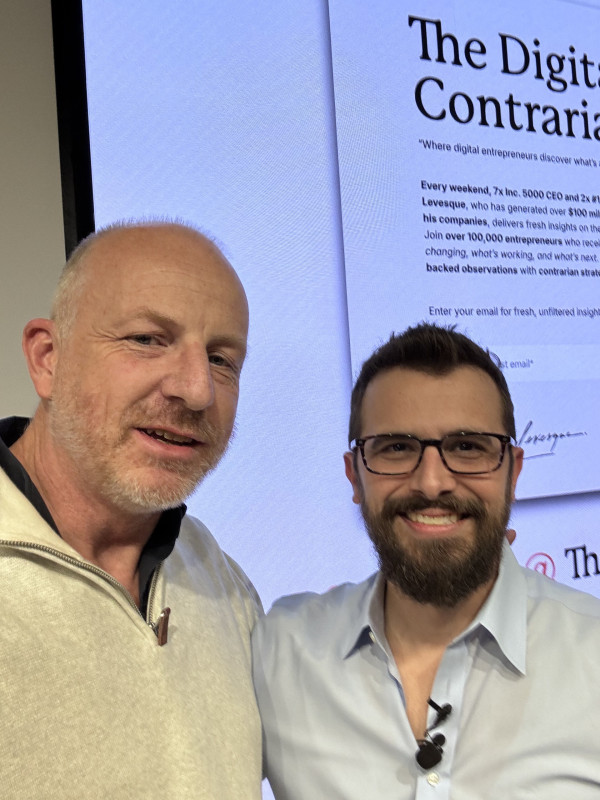
The Ask Method mentions a memory course called “Total Memory Improvement”.
Ryan rebranded it and let the domain expire.
Guess who bought it 🙂
Since then I’ve been running a test on the site for how good you are at remembering names.
It’s built a fairly substantial list with no real effort and a good stream of affiliate revenue from another memory course (Ryan’s no longer operates, or I’d have sent the traffic there).
The test is one of three types that Ryan talked about called the “benchmark”. Anything that shows people up as being “below average” can prompt them to do something about it.
To wrap up, Ryan’s ASK method still has relevance 10 years on, but the most powerful part isn’t the quiz funnel, but the research you do before you build it.
